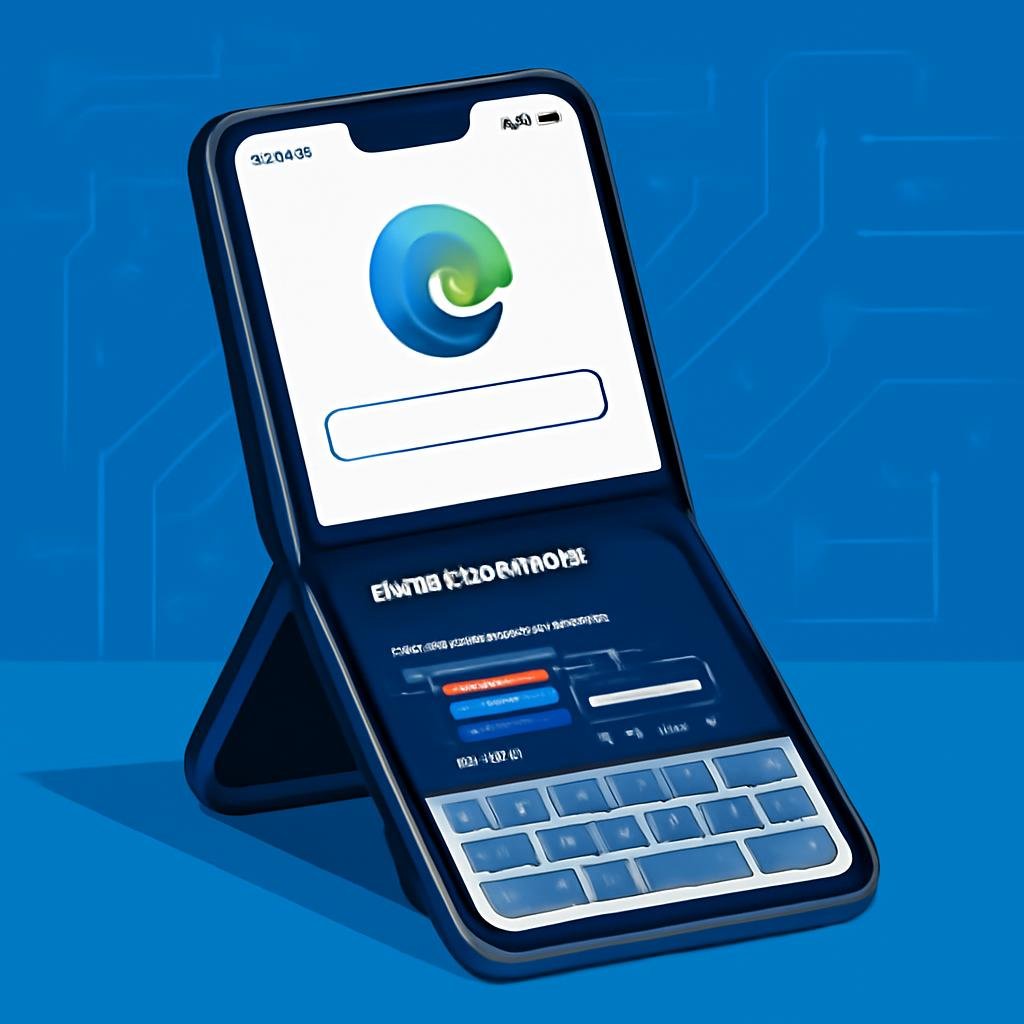
Google AI Studio product and design lead Ammaar Reshi has demonstrated Windows 11 running locally on an iPhone Duo without jailbreaking it. His WindowsiOS project runs the Arm edition of Windows 11 24H2 on Apple’s first foldable, released about three weeks earlier.
Reshi’s November 11, 2026 demo shows a retail Windows installation running Microsoft Edge and Google’s Antigravity coding app. Both apps support touch input in the demonstration.
When the phone is partly folded, its lower screen provides a keyboard and trackpad. Opening it fully lets Windows use the entire 7.6-inch display.
The project is not an App Store download. Installation requires an Apple Silicon Mac with Xcode and a Windows 11 Arm image supplied by the user. Reshi has published the WindowsiOS source code on GitHub.
There are substantial limits beyond setup. Windows can use only 4.5GB of the phone’s 12GB of RAM. Reshi removed more than 35 Windows background services, including Defender, bringing idle memory use to about 1.46GB.
The project’s README claims near-native performance but provides no benchmarks to support that claim. Testing has also been limited to the iPhone Duo.
WindowsiOS relies on code translation rather than hardware virtualization. Apple blocked hypervisor access on unmodified iOS devices starting with iOS 16.4, ruling out that route.
Instead, the translator converts Windows Arm code into Arm code that the Duo’s A20 Pro processor can execute directly. The shared instruction set helps make this possible. A similar advantage recently enabled Nintendo Switch games to run natively on iPhones.
The underlying translator comes from Henge, an open-source project previously used to run macOS on modern iPhones. WindowsiOS’s README credits Gemini 4 Carbon with all Windows-specific engineering. Google made Carbon available to developers and AI Ultra subscribers during the week of the demonstration.
Running the translator also depends on an unofficial workaround. A debugger must be attached to the phone at every launch to enable the executable memory it needs. Some iPhone emulators that require just-in-time compilation use the same approach.
Apple could block that workaround in a future iOS release, as it previously blocked hypervisor access.
Earlier efforts show why the translation method matters. In 2024, Tiny11’s developer booted a stripped-down Windows build on an iPhone 15 Pro through the UTM SE emulator. Reaching the desktop took roughly 20 minutes, largely because UTM SE interprets each instruction in software.
WindowsiOS also follows an experiment in the opposite direction. In late October, a developer demonstrated iOS 26 on Microsoft’s Surface Duo 2, according to Windows Latest. That developer plans to bring the iPhone Duo’s iOS 27 build to the Microsoft phone next.